
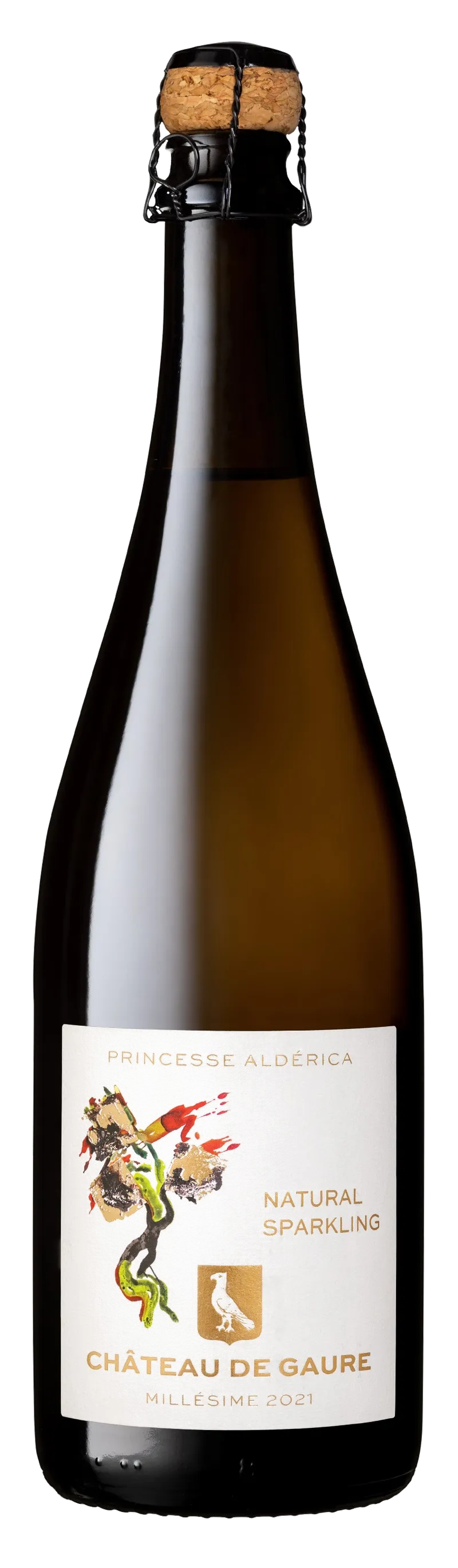
White · AOP Limoux
Princesse Aldérica
A natural sparkling wine from two Limoux terroirs: the clay-limestone slopes by the château, tempered by maritime winds, and the cooler, deep-clay altitude of Campagne-sur-Aude near the Pyrenees. Organic since 2008, Biodyvin-certified since 2022.
- Terroir
- Château de Gaure & Campagne-sur-Aude
- Blend
- 100% Mauzac
- Alcohol
No prices · No cart · No login
The Legend
The legend of Aldérica.
For each vintage, Pierre Fabre selects one or two exceptional barrels to become Aldérica — sometimes red, sometimes white. If a vintage offers nothing he judges worthy of the name, there is no Aldérica that year.
Rare editions to discover
- Aldérica Rouge 2011
- Aldérica « Arnaud Rouge » 2018
- Aldérica « Arnaud Blanc » 2019
- Aldérica « Grand Chardonnay » 2019
- Aldérica « Grand Chenin » 2019
- Aldérica Natural Sparkling 2021
Midway between Carcassonne and Limoux stood, since prehistory, an important oppidum — occupied later, tradition says, by Romans, Visigoths and Moors, before being destroyed by the Duke of Aquitaine in 719.
Long ago, in that citadel, lived a beautiful, smiling young woman named Aldérica, daughter of the Visigoth king. She and the people of the city lived happily, until barbarian horsemen, the Saracens, invaded the kingdom and laid siege to the city.
Bravely defended by Aldérica and her people, the city repelled every assault. But the Saracens piled wood before the gates and set it alight. Once the gates had burned, they poured into the city.
Overwhelmed, the defenders were quickly killed. Aldérica used a brief lull, while the Moors were occupied with looting and burning, to take refuge with the women and children in the chapel at the top of the town.
When the chapel door gave way, Aldérica found herself face to face with the Saracen chief. Struck by her beauty, he pulled her outside and tried to kiss her. Mad with shame, Aldérica pushed the emir violently away — he fell and was impaled on one of his own guard's swords.
Furious, the Saracens avenged their chief by running the young woman through with twenty lances. Where her blood fell, a juniper tree grew — still alive twelve centuries later, green even at the height of summer. The tree stands as the hope of the Occitan people, who, despite fire and ruin, still lift their heads. Whoever passes by, admire this tree, and steep your soul in it. Thinking of the past, build the future.